Journal
You've Been Looking Through It This Whole Time
The crystal is the only part of a watch whose highest ambition is to go unnoticed. Acrylic, mineral, sapphire — and why the hardest one has the worst failure mode.
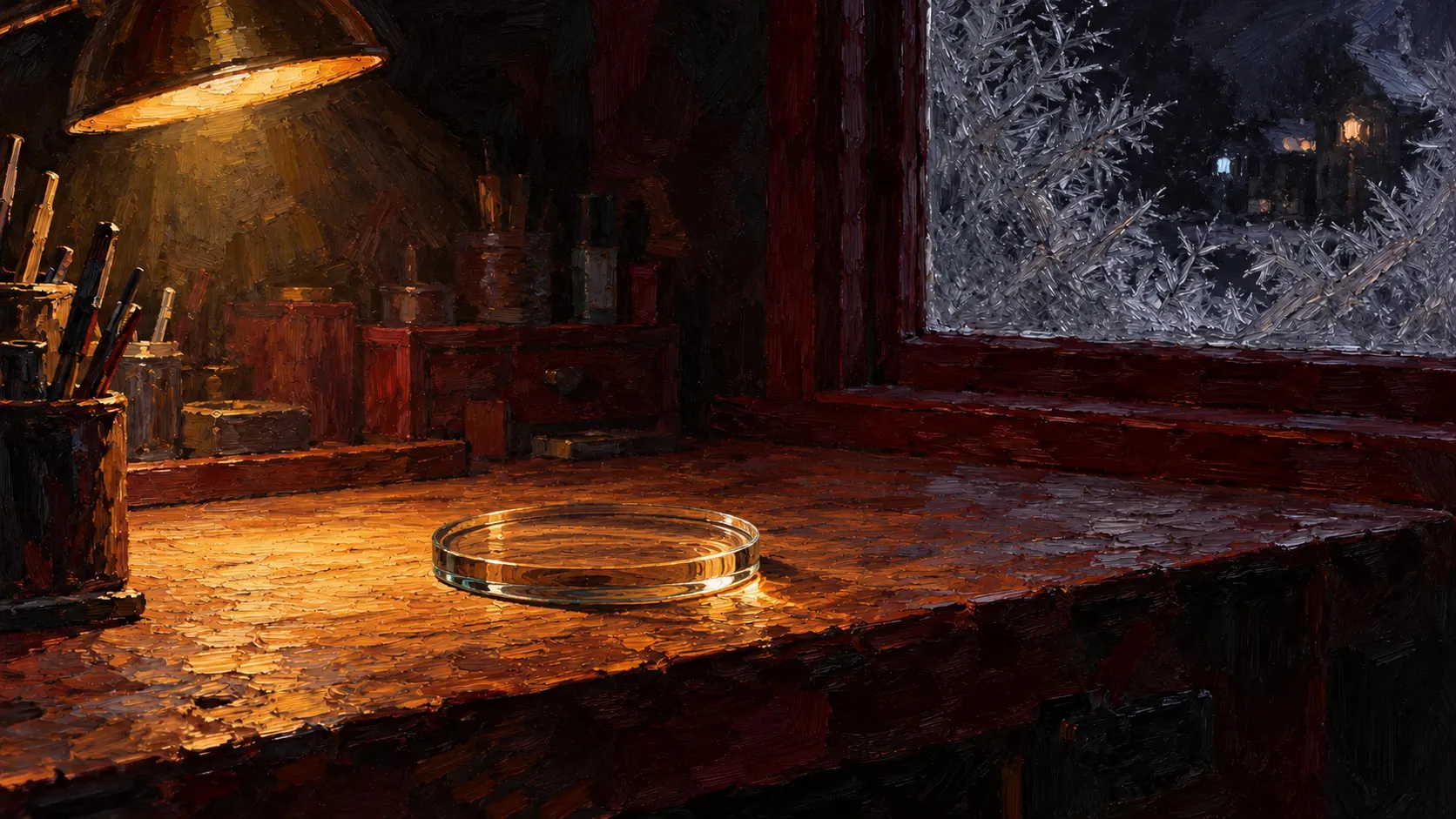
The closer. We've done the maker, the movement, the dial and the case. This is the last pillar — and the one you've been looking through the entire time.
Here's a strange thing about the object on your wrist.
Every other component is trying to be seen. The dial wants your attention. The hands want to be legible. The case wants to catch light along a bevel. Even the movement, sealed in the dark, was finished by somebody who hoped you'd eventually look.
The crystal wants none of that.
The crystal's entire ambition is to not be noticed — and watchmakers spend an extraordinary amount of money and effort building a window they can persuade you isn't there.
Which is a peculiar kind of art, and it's the one that changes everything else you see.
Three materials, and they are genuinely different
Acrylic — you'll hear it called plexi, perspex, or just plastic, and most makers who use it have their own trade name for it. It's soft. Around 2 or 3 on the Mohs hardness scale, which means it will pick up a scratch from a doorframe, a zip, a supermarket trolley, and possibly a stern look.
And it does not matter, because you can polish those scratches out in about five minutes with a tube of paste and a cloth. A scratched acrylic crystal is a chore. It is never a problem.
It also has a warmth to it. Acrylic has a faint golden cast and a slight softness that makes a dial glow rather than sit flat. Every vintage watch you've ever admired in a photograph was almost certainly wearing one, and putting sapphire on a 1960s watch is a bit like re-varnishing an old painting with gloss.
Mineral glass — hardened glass, around 5 or 6 on Mohs. Sits in the middle and inherits the wrong halves of both neighbors. Harder than acrylic, so scratches take more to inflict — but unlike acrylic you can't polish them out, and unlike sapphire it isn't hard enough to avoid them.
It's cheap, it's clear, and it does the job. It's just very rarely the reason anyone loves a watch.
Sapphire — and here's the fact that surprises people: it isn't mined. Watch crystals are synthetic corundum, which is aluminum oxide, grown in a furnace. The original flame-fusion process dates to around 1902, and modern methods grow large cylindrical boules that get sliced into discs.
It's a 9 on Mohs. Diamond is 10.
Which sounds like almost as hard as the hardest thing there is, and this is where nearly everyone's intuition goes wrong.
Mohs is not that kind of scale
Mohs is ordinal. It ranks what scratches what; it says nothing about the size of the gaps. The jump from 9 to 10 is enormous — far bigger than the jump from 2 to 9.
But for daily life, that hardly matters, and here's why sapphire genuinely earns its place: ordinary dust and grit is mostly quartz, which is a 7. Sand, dust, the film on a desk, the stuff on your car door — all of it is comfortably below sapphire.
So in practice, sapphire is scratched by diamond, by corundum abrasives, and by a small handful of industrial materials you are unlikely to encounter while making coffee. A sapphire crystal on a watch worn every day for twenty years can look untouched.
But hardness is not toughness, and this is the part nobody puts in the brochure.
Hard means resistant to scratching. Tough means resistant to breaking. They are different properties and they often trade against each other.
Sapphire is very hard and comparatively brittle. Catch a sapphire crystal on a stone corner at the wrong angle and it can crack or shatter — in a situation where an acrylic crystal would have taken a scuff and shrugged.
So the "better" material has the worse failure mode. Acrylic fails gradually and reversibly. Sapphire fails suddenly and expensively.
That's not an argument against sapphire. It's an argument for understanding what you've got.
Shape, which is where it stops being a window and starts being optics
Now the interesting bit, and the reason this belongs in a series about kinetic art.
A flat crystal is honest. It shows you the dial as it is, edge to edge.
A domed crystal curves, which means it refracts. Tilt the watch and the outer edge of the dial stretches, compresses and slides. The minute track appears to bend away from you. Nothing on the dial has moved — the geometry of the glass is doing it.
A box crystal — flat on top with vertical walls, like a small aquarium — gives you the most dramatic version. The dial appears to sit at the bottom of a shallow well, and the walls distort everything near the rim into a soft, watery curve as your wrist turns.
This is genuinely one of my favorite effects in the whole hobby, because it is motion with no mechanism at all. No power reserve required. No complication. Just a curved piece of transparent material and the fact that light bends when it changes medium.
And the modern trick is the double-domed sapphire — curved on both surfaces — which recreates the vintage acrylic distortion while being effectively unscratchable. You get the swimming edges and none of the anxiety.
Anti-reflective coating, and the blue flash
Sapphire has a refractive index around 1.77, which means roughly eight percent of the light hitting each surface bounces straight back off it. Two surfaces, and you're losing a meaningful amount of what you're trying to see — plus getting a mirror of your own face over the dial.
Anti-reflective coating is a microscopically thin layer applied so that light reflecting off its top surface and light reflecting off the boundary underneath arrive out of phase and cancel each other out.
It can't do that for every wavelength at once. So the wavelengths it doesn't cancel are what you see — which is exactly why an AR-coated crystal flashes blue or violet at an angle.
That blue isn't a tint. It's the leftovers.
There's a real design decision underneath it. Coat only the inside and the coating is protected forever, but you still get reflections off the outer face. Coat both sides and the crystal can genuinely vanish — the watch looks like an open dial with nothing over it — but the exterior coating is soft and will eventually wear, and a worn AR coating looks considerably worse than no coating at all.
And a heretical opinion, freely offered: a fully AR-coated crystal photographs magnificently and can look slightly dead in person. A little reflection gives a dial a surface. It tells your eye there's something there. Some of the best-looking watches deliberately keep a bit of it.
The service-counter argument, which is the whole subject in one decision
Here is where this stops being theory, and it happens in a workshop several times a week.
A vintage watch comes in for service. Its acrylic crystal is scratched, hazed, maybe yellowed — sixty years of pockets and door frames. And a modern sapphire replacement can be cut to fit.
The sapphire is harder. It will never scratch again. It is clearer, flatter, more durable, and by every measurable standard it is the better component.
Almost nobody who knows what they're doing fits it.
Because a sapphire crystal on a 1960s watch looks wrong, and it takes a while to work out why. Acrylic has a faint warmth and a softness at the edges that flatters an aged dial. Sapphire is optically neutral and completely flat, and against sixty-year-old patina that neutrality reads as clinical — like re-varnishing an old oil painting with gloss. The watch stops looking its age and starts looking restored, which is not the same thing and is usually worse.
So the correct answer, over and over, is: fit another acrylic crystal. The soft one. The one that will be scratched again within a year, and that the owner will polish out with a tube of paste in five minutes, and that will be replaced again in a decade.
That's a real decision, made deliberately, in favor of the objectively worse material — because better was never the only axis.
And there are watches sold new today on the same logic. Where a maker offers the same model with acrylic or sapphire, the acrylic version is usually the historically faithful one, usually the cheaper one, and very often the one collectors insist on. The soft plastic disc is the purist's choice, and the shop has to explain that to people several times a week.
Why it closes the series
We started this whole thing with the idea that a watch is a mosaic — a picture made of pieces that are not, individually, a picture. The maker. The movement. The dial. The case and the band.
And then there's a transparent disc sitting over all of it, which you have never once looked at.
Everything you've admired in this series, you admired through something. The color of that salmon dial, the shimmer on that nacre, the crosshatch on the meteorite — all of it arrived at your eye slightly warmed, or slightly bent, or slightly flattened, by a component whose entire job was to stay out of the way.
Most art forms don't have this. A painting doesn't come with a lens. A sculpture isn't glazed.
A watch is looked at through a piece of grown crystal, chosen and shaped and coated by somebody who thought hard about how you'd see everything else — and who then hoped very much that you'd never think about them at all.
Which, honestly, is the most watchmaking thing in this entire series.
That's the five pillars: the maker, the calibre and its complications, the dial, the case and the band, and the crystal on top. Thanks for reading all of it.