Journal
The Most Beautiful Dial in Watchmaking Is a Mollusc's Coping Mechanism
Mother-of-pearl doesn't have a color. It has a structure — microscopic layers that split light and send it back differently depending on where you're standing. It is the only dial material that is genuinely kinetic on its own.
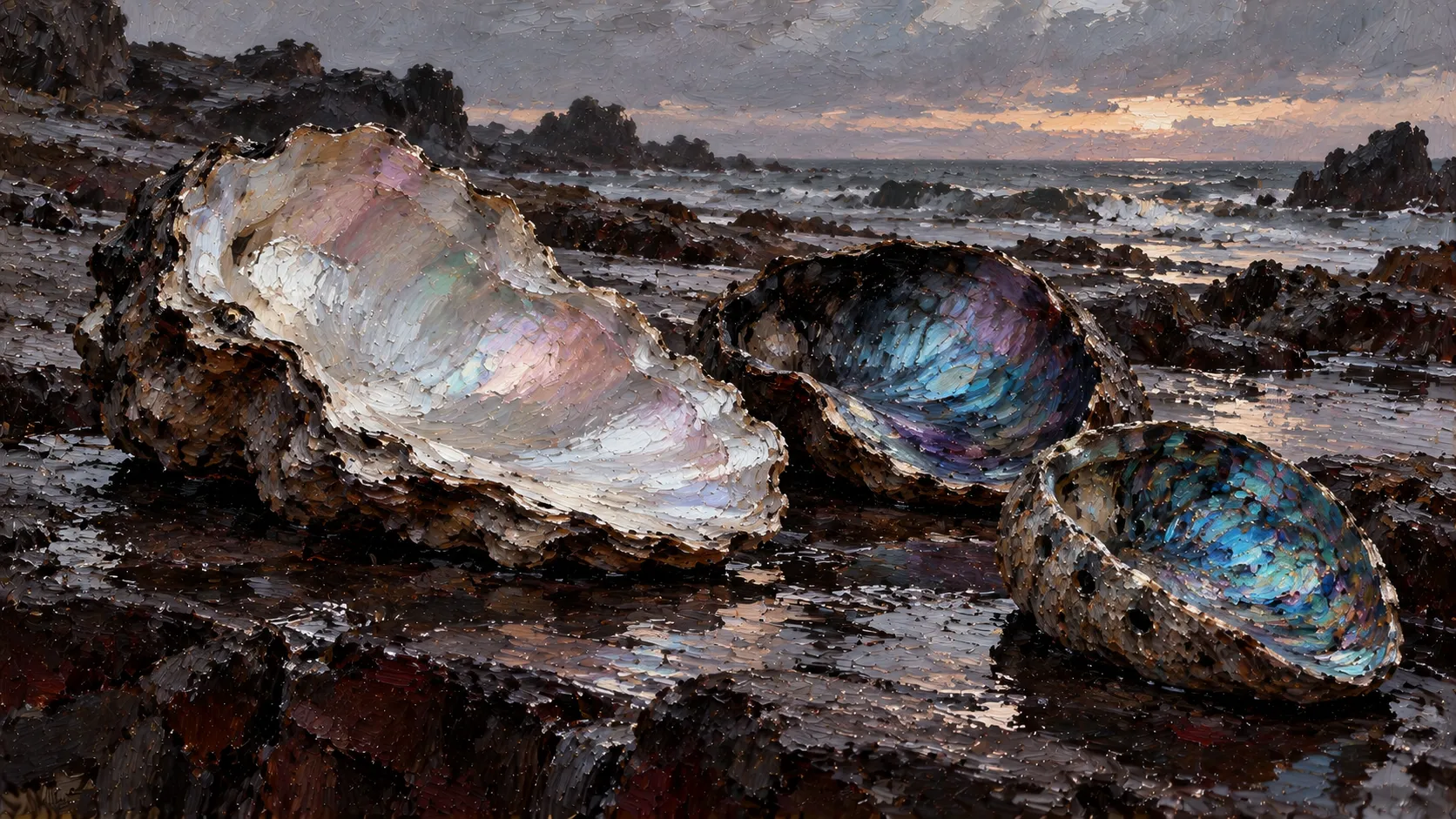
Third in a four-part series on dial materials. Meteorite, stone, shell, metal.
Let's start with the unromantic version.
Mother-of-pearl is the substance a mollusc secretes when something gets inside its shell and it can't get rid of it. It coats the intruder, layer after layer, until the problem is smooth and harmless.
That's it. That's the whole origin story. It is, functionally, an animal's way of handling an annoyance it can't remove — a biological shrug — and we cut it into discs, put it under sapphire, and charge accordingly.
I say this with total affection, because the actual physics of the stuff is glorious.
It doesn't have a color
This is the bit that changes how you look at it.
Nacre — the proper name for mother-of-pearl — is built like a brick wall. Microscopic platelets of aragonite, a form of calcium carbonate, stacked in overlapping layers and mortared together with a protein called conchiolin. The platelets are on the order of half a micron thick, which happens to be about the wavelength of visible light.
So when light hits nacre, it doesn't just bounce. It enters, reflects off successive layers, and the reflections interfere with each other — reinforcing some wavelengths and canceling others. Which colors survive depends on the angle you're looking from.
Which means mother-of-pearl has no pigment. Grind it up and it's a dull white powder. The color isn't in the material. The color is the material's architecture, doing something to light.
That's why a nacre dial shifts from pink to green to gold as your wrist turns, and why it photographs so badly. A photograph fixes one angle. The whole point of nacre is that there is no one angle.
Which makes it, for my money, the single most kinetic surface in watchmaking. A guilloché dial needs light to move across it. A sunburst needs the wrist to turn. Nacre changes continuously, in color, with every degree of movement, at every moment of the day.
It's a moving image that requires no mechanism whatsoever.
And it's tough
Second surprise. This brick-and-mortar structure isn't just decorative — it's one of the most studied structures in materials science.
Aragonite on its own is chalky and brittle. Nacre made of the same mineral is dramatically tougher, because the protein layers between the platelets absorb energy and stop cracks propagating: a crack has to keep diverting around each platelet instead of running straight through. Materials engineers have spent decades trying to copy the trick for armor and composites.
A shellfish worked it out first. Without a meeting.
The varieties
White nacre comes mostly from the large Pinctada maxima oyster — silver-white with pale pink and green shifts. This is the classic, and it's what most people picture.
Tahitian black-lip nacre comes from Pinctada margaritifera, and it's the interesting one: a dark gray-to-charcoal base with peacock flashes of green, aubergine and blue running through it. Against a dark dial the effect is closer to oil on water than to jewelry.
Abalone — paua — is a different family altogether and is the loudest of the lot: electric blues, greens and violets in a chaotic swirl. It's not subtle and it isn't trying to be. On the right watch it's spectacular. On the wrong one it's a bathroom tile.
The honest bit about color
Plenty of colored mother-of-pearl dials — the salmons, the strong blues, the greens — are dyed. That's normal, it's been done for a long time, and it's not deception when the maker says so.
It is worth knowing, though, because natural and dyed nacre behave differently. Natural nacre's color comes from that structural interference, so it shifts. Dyed nacre has pigment sitting in the material as well, so the color tends to stay put more and shift less.
The tell: tilt it. If the color holds steady and only the sheen moves, there's pigment involved. If the hue itself travels across the dial as you turn your wrist, that's structure.
Nobody will ever ask you to do this. But you'll do it now, in a shop window, and you'll know.
Cutting it
Nacre arrives curved, because shells are curved. It has to be sliced, flattened and stabilized, and it's typically finished at around three-tenths of a millimeter — thin enough that it's fragile, and thin enough that the backing behind it affects what you see through it.
The layers also run in a direction. Cut across them and the shimmer runs one way; cut differently and the whole character changes. A dial maker choosing where in the shell to take a slice from is making an aesthetic decision, the same way a woodworker chooses which way to open a book-matched panel.
And of course no two pieces match. Same limitation as stone and meteorite, same consequence: two people with the same reference own visibly different watches.
One thing I'd like to see change
Mother-of-pearl spent decades stuck in a category. It went on smaller watches, it usually came with diamonds, and the industry filed it under "ladies' models" and stopped thinking.
That was always a bit daft, and it's finally shifting — nacre now turns up on serious complicated pieces, on chronographs, on watches nobody would call delicate.
Good. It's the most optically sophisticated material anyone puts on a dial. It deserved better than a demographic.
Next, and last in the series: metal. Which sounds like the boring one, and is quietly the hardest — because when there's no exotic material to hide behind, all you've got left is the hand.