Journal
The Hardest Dial to Make Is the One That Just Looks Like Metal
No meteorite, no gemstone, no shell. Just brass, a machine from the nineteenth century, and forty hours. Guilloché, grand feu enamel, sunburst, salmon and frosting — where the hand has nowhere to hide.
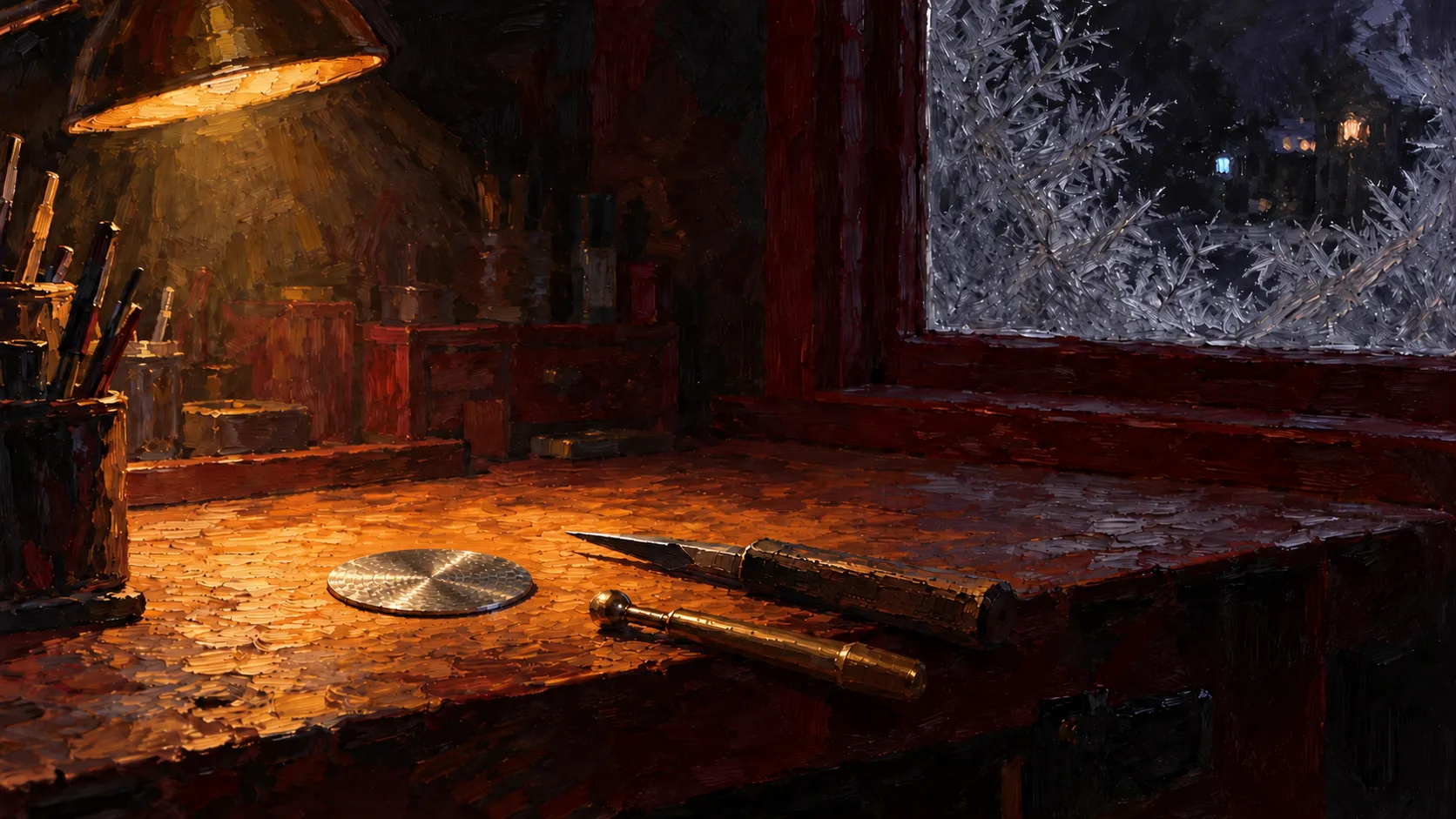
Last in a four-part series on dial materials. Meteorite, stone, shell, metal.
We've done a rock from space, a rock from a mine, and a shell.
Now the one that sounds like an anticlimax: metal.
A metal dial has no story to lean on. Nobody's going to lean over your wrist and gasp because your dial is brass. There's no geology, no astronomy, no mollusc.
Which is exactly why it's the hardest thing in the category. When the material contributes nothing, everything you're looking at is somebody's hand.
Guilloché: the machine older than the company
Guilloché — engine-turning — is a pattern cut into metal by a machine called a rose engine or a straight-line engine. Barleycorn, clous de Paris, sunray, waves. Breguet made it famous around 1800 and the tool has barely changed since.
Here's what people get wrong. It isn't stamped, and it isn't automatic. The operator turns a crank by hand while the workpiece rocks against a cutting tool, guided by a shaped pattern bar called a rosette. The depth of the cut is measured in hundredths of a millimeter. The operator controls the feed by feel.
One pass. Then the next. Hundreds of them, across a disc the size of a large coin, and each one has to land in exactly the right place relative to the last.
There's no undo. Go too deep on pass two hundred and eleven, and you have a scrap dial and a wasted week.
Some of the machines still in daily use are older than most of the brands using them. There are workshops running rose engines from the 1800s because nobody has built a better one, and there are, at any given moment, not very many people alive who can operate them well.
Look at a proper guilloché dial under raking light and watch the pattern pump as you tilt it — light running along the ridges and dying in the valleys. That's an optical effect built by hand, one groove at a time.
Grand feu enamel: an argument with a kiln
Then there's enamel, which is where watchmaking stops being difficult and starts being unreasonable.
Grand feu — "great fire" — means powdered glass laid onto a metal base and fired in a kiln at around 800°C. The powder melts and fuses into a glass surface. Then you do it again. And again. Five, seven, sometimes more firings, building depth layer by layer.
Every single firing can destroy the piece. Bubbles. Cracks. A speck of dust that becomes a permanent black dot. Colors that shift because the kiln ran a few degrees hot. Metal and glass expanding at different rates and tearing apart on cooling.
There's no repairing an enamel dial. There's only starting again.
Which is why serious enamel workshops talk about failure rates the way a farmer talks about weather. A significant fraction of pieces never make it, and that loss is baked into what the survivors cost.
The families are worth knowing:
Cloisonné — thin gold wires bent by hand into outlines, forming cells, each cell filled with a different color. This is how you get those enamel map and animal dials.
Champlevé — cells carved out of the metal instead, then filled.
Flinqué — enamel laid transparent over guilloché, so the pattern glows up through the glass. Two crafts stacked, each capable of ruining the other's work.
Paillonné — tiny gold foil motifs sealed between enamel layers, suspended in the glass like things in amber.
And the payoff is real. Enamel doesn't fade. Ever. Paint yellows, lacquer ages, printed dials degrade — a properly fired enamel dial will look identical in three hundred years, because it's glass, and glass has no opinion about time.
It's the only part of a watch that will outlast the watch.
Sunburst: the cheapest trick and the best one
Now the one you almost certainly own.
A sunburst — or sunray — finish is made by brushing the dial radially from the center outward, so every scratch runs along a radius. Light hitting the dial reflects along those lines, which means there's always a bright band running across the dial, and it moves as the watch turns.
Tilt it and the bright zone sweeps around like a small sun setting on your arm. That's not a metaphor for movement. That's the actual optical behavior.
For my money the sunburst dial is the most underrated object in this whole hobby. It's on watches at every price point, it costs comparatively little to produce, and it does something genuinely kinetic all day, every day, for free.
Its cousin the fumé or degradé dial — bright at the center, darkening to near-black at the rim — is usually a sprayed lacquer gradient, and it works because it fakes a vignette. Your eye reads it as depth. It isn't. It's a flat disc lying to you convincingly.
Salmon, which isn't a paint
Quick one, because it's a favorite and it's widely misunderstood.
A salmon dial's pinkish, coppery, slightly warm tone doesn't usually come from paint. Historically it came from the alloy: silvered or gold dials with a proportion of copper in them read pink. The color is in the metal, not on it.
That's why salmon dials have a particular quality that pink paint can't reproduce — the color changes as the light changes, because you're seeing metal, not a coating. In flat light it's almost beige. In warm light it glows.
And then it goes vintage-adjacent and shifts again over decades, which is why old salmon dials are so specifically loved.
Frosting, hammering, and the deliberate rough
The counter-movement to all this precision is texture that's meant to look struck rather than machined.
Frosted surfaces — where gold is worked with a diamond-tipped tool until the surface is covered in microscopic craters that scatter light into a sugar-like sparkle. The technique is Florentine and ancient; it turned up in watchmaking relatively recently and made everyone reconsider what a precious-metal dial could look like.
Hammered dials, where the marks are visibly, unapologetically made by an implement being hit.
Sandblasted and grained dials, which absorb light instead of throwing it, and exist mainly to make the hands and indices float.
All of them are a rejection of the same idea: that the highest form of finishing is one where you can't see the process. Sometimes the process is the point.
Why this is the hard one
So, the argument, and then I'll leave you alone.
Meteorite is astonishing because of what it is. Stone is astonishing because of what happened to it underground. Nacre is astonishing because of what an animal did to a grain of sand.
A metal dial is astonishing only because of what a person did last Tuesday.
There is no material story. There's no geology to hide behind and no marketing line about the cosmos. It's brass, or gold, or silver — and then a human being, a machine that predates the electric light, and a very large number of hours.
That's why the great dial makers are the least famous people in watchmaking and the most respected within it. Their work is invisible as work. It just looks like a dial.
Which, in the end, is the highest compliment this craft has.
That's the dial materials series. Meteorite, stone, shell, metal — four completely different answers to a disc thirty millimeters across.