Journal
The Rock That Fell Out of the Sky and Got a Job
A meteorite dial carries a pattern that cannot be manufactured, faked, or hurried — it needs a few million years and a vacuum. Here's how it forms, why no two dials match, and which watches actually carry which rock.
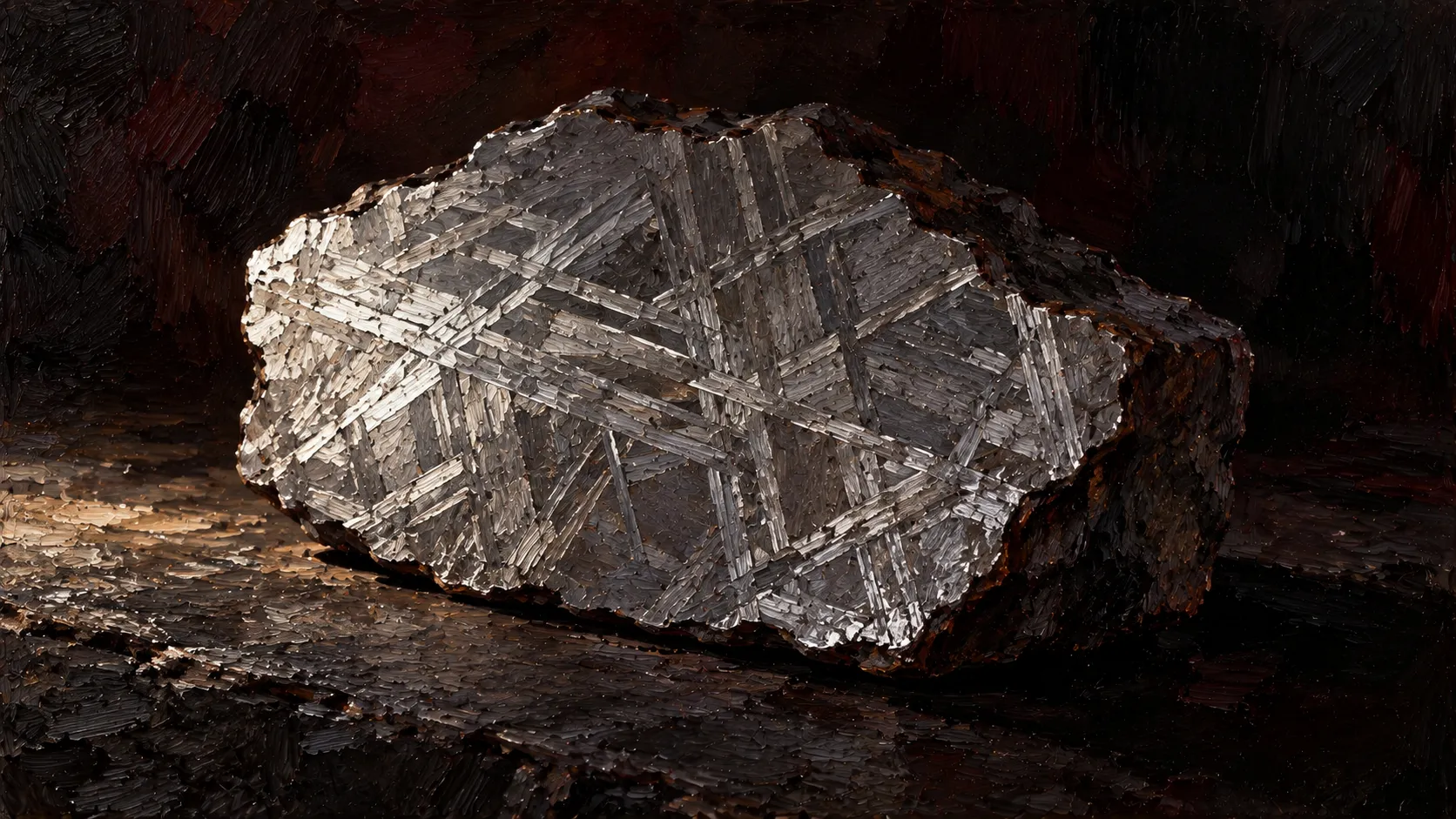
First in a four-part series on dial materials. Meteorite, stone, shell, metal.
The oldest thing you can legally strap to your wrist is about four and a half billion years old, and it arrived here entirely by accident.
Let me explain what you're actually looking at, because it's better than the marketing copy.
The pattern that cannot be faked
Iron meteorites aren't really "rocks from space." Most of them are pieces of the core of a small planet that no longer exists — a body that got big enough to melt and separate, with the heavy metal sinking to the middle, and then got destroyed in a collision early in the solar system's life.
So the metal that ended up in your dial spent its formative years insulated under hundreds of kilometers of rock, in a vacuum, cooling at something like one degree per million years.
At that pace, the iron-nickel alloy does something it can't do in any furnace on Earth. It crystallizes into two interlocking minerals — kamacite, low in nickel, and taenite, high in nickel — that grow into each other in a lattice of long, straight, interlocking bands.
Slice it, polish it, and etch the surface with dilute acid, and the two minerals eat away at different rates. The lattice appears.
That's the Widmanstätten pattern, and here's the part I want you to sit with: it is the only decorative surface in watchmaking that functions as a timestamp. You cannot make one. Not with better tooling, not with more money. The pattern is physical proof that a piece of metal cooled slowly for millions of years, and nothing on this planet has ever had that kind of patience.
(Small historical footnote, because it's the sort of thing that delights me: the pattern is named after Alois von Widmanstätten, who observed it in 1808 — four years after William Thomson had already described it. Thomson published in Italian, in a journal nobody read, and then died. Four and a half billion years of cosmic drama, undone by poor distribution.)
Coarse or fine — and why your dial looks the way it does
Not all meteorite dials look alike, and the difference isn't stylistic. It's classification.
The width of those bands depends on nickel content and cooling rate. Slower cooling grows wider bands. Classifiers sort iron meteorites by exactly this, from coarse octahedrite through to fine octahedrite, and it shows up directly on the wrist:
Muonionalusta, from northern Sweden, is a fine octahedrite — tight, dense crosshatch, almost fabric-like at a distance.
Canyon Diablo, the iron that made Meteor Crater in Arizona, is coarse — broad, dramatic, architectural bands.
Same material, same physics, wildly different dials. If you've ever wondered why two meteorite watches look nothing like each other, that's why — and you can look up the classification before you look at the watch.
The three rocks you'll actually meet
Working from our own catalog, three names come up again and again.
Gibeon — Namibia, a strewn field of iron scattered across the desert in prehistory, roughly 26 tonnes cataloged. This is the classic. It's the rock in Rolex's meteorite-dial Daytona, GMT-Master II and Day-Date variants. Namibia has since restricted its export, which is why Gibeon increasingly appears in historical references rather than new ones. A finite dial material, running out in real time.
Muonionalusta — northern Sweden, near the Finnish border, hit the planet roughly a million years ago. This is the modern workhorse: Jaeger-LeCoultre's Master Calendar, De Bethune's DB28 Aérolite, Bulova's Lunar Pilot Meteorite. When a brand released a meteorite dial in the last decade, the odds are good it's this.
Seymchan — Russia, and the strange one. Seymchan is a pallasite: not solid metal, but olivine crystals suspended in an iron-nickel matrix. Olivine is the gemstone we call peridot. Pallasites are believed to come from the boundary between a planetesimal's metal core and its rocky mantle — the seam where two worlds met inside one body that then blew apart.
Cut a Seymchan dial and you get translucent green-gold gems floating in metal. It is, genuinely, the most beautiful material in this entire subject, and it is a nightmare to work: crystal and metal have different hardnesses and want to be cut, polished and finished in completely different ways.
And then it gets silly
Iron meteorites are the mainstream. The far end of this hobby has gone considerably further, and our catalog tracks it.
Chondrites — stony meteorites like Allende, which fell in Mexico in 1969 — contain calcium-aluminum inclusions that are among the oldest solid matter ever dated. H. Moser & Cie. put Allende on a tourbillon dial. That watch has something on the front of it older than the Earth it's telling the time on.
Lunar meteorites — rock blasted off the Moon by an impact, drifting for an unknown span, landing in a desert here. Louis Moinet has used several from Oman and Libya.
Martian meteorites — same story, different planet. Tissint fell in Morocco in 2011 and was actually witnessed. Shergotty fell in India in 1865. Graham's Tourbillon Orrery went as far as making the Mars and Moon spheres in a mechanical solar system from actual Martian and lunar meteorite — a model of the solar system, built partly out of the solar system.
At which point we should probably all sit down.
The unglamorous engineering
Right. The practical reality of turning a chunk of dead planet into a dial.
It rusts. It's iron with nickel, and after thousands of years buried on Earth it's picked up chlorides that will happily keep corroding forever. Meteorite dials are stabilized, then usually plated — rhodium is common — or coated. An untreated meteorite dial under a crystal would eventually "sweat," and it isn't pretty.
It's cut thin. We're talking a few tenths of a millimeter, and the pattern only appears after etching, which means the finisher is working blind until near the end.
The yield is bad. Cracks, inclusions and voids run through the material invisibly. You cut, you etch, you look, and sometimes you throw it away.
And there are no reruns. Two dials from the same slab won't match, because the lattice is three-dimensional and every cut is a different section. A brand can't reorder a batch. When the block runs out, that dial ends.
That last one is the thing that separates meteorite from every other material in watchmaking. When a brand issues a "limited edition," it's usually a decision made in a meeting.
With meteorite, the limit is arithmetic. There is only so much of it, it is not being restocked, and the supply is genuinely, permanently finite.
Why it works as art
You could argue — some do — that a meteorite dial is a gimmick. Space rock! On a watch! Buy it!
I'd push back, and the reason is the thing I said at the top.
Every other beautiful dial is a record of somebody's skill. The guilloché is a person's afternoon. The enamel is a person's decade. That's craft, and it's wonderful, and I'll spend a whole post on it.
A meteorite dial is a record of time itself — the one thing a watch is fundamentally about, made physical, and on a scale so far beyond the object that it becomes almost funny.
Four and a half billion years of patient crystallization. Sliced up. Told to report your dentist appointment.
I love it. I love it unreservedly.
Next in the series: stone dials — lapis, malachite, opal, onyx — and why somebody in a workshop is going to break an expensive piece of rock with a drill bit today, and then do it again.
Meteorite classifications, fall locations and recorded watch uses in this piece are drawn from our own catalog, which tracks 26 meteorites and 63 documented uses in watches. Corrections welcome — that's what the corrections policy is for.