Journal
You Buy a Watch for the Dial. You Live With the Case and the Strap.
Platinum, white gold, rose gold, steel, titanium, bronze — and why the band you put it on changes the watch more than anything else you can do to it.
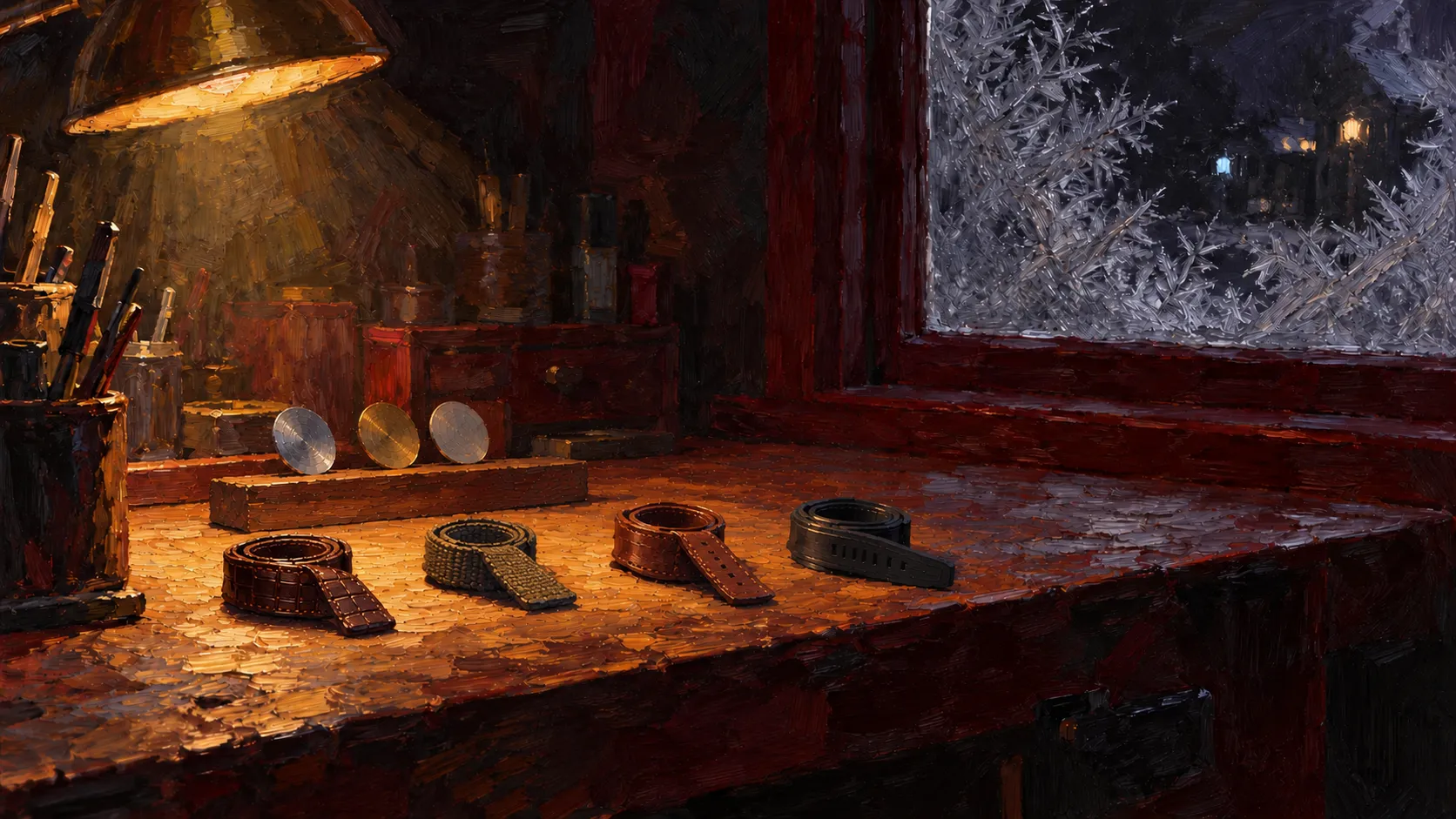
Nobody has ever picked up a watch and said "lovely case alloy."
And yet the case metal is quietly the biggest decision anybody makes about a watch. It sets the weight, the color temperature of everything on the dial, how light behaves across the whole object, and — this is the one people underestimate — how the thing feels on your arm at four in the afternoon when you've stopped thinking about it.
Then there's the band, which is the only part of the artwork that actually touches you.
Let's do both.
Steel, which is not the compromise
Start here, because steel gets treated as the entry-level option and it absolutely isn't.
Steel is hard, so it holds a crisp edge. That matters more than it sounds: the thing that makes a well-made case beautiful is the boundary between a brushed surface and a polished bevel, and steel will keep that line sharp for decades. Softer metals blur it.
Most of the industry uses 316L. Rolex famously uses 904L — they call it Oystersteel — which is more corrosion-resistant, takes a slightly brighter, denser-looking polish, and is meaningfully more annoying to machine. It eats tools.
Steel is also the honest choice for a watch you intend to use. A steel sports watch that's been knocked about for fifteen years reads as a life. The same watch in gold reads as an accident.
Yellow gold
18 carat means 750 parts per thousand gold, alloyed with silver and copper to make it hard enough to survive being an object.
Yellow gold was the default for most of the twentieth century. Then the nineties happened, steel sports watches took over, and yellow gold spent about twenty years being the thing your uncle wore.
It's back, and it's back for a good reason: yellow gold does something to a dial that no other metal does. It's warm, so it pushes cream dials toward ivory and makes black look like ink rather than a hole. If you've ever wondered why a vintage watch photograph looks softer than a modern one, quite often that's just gold doing its job.
Rose gold (and the copper problem)
Rose gold is the same 750 parts gold with the alloy pushed toward copper. More copper, redder result — the trade calls the warmer version 5N and the paler pink 4N.
Here's the honest bit brands don't lead with: copper-heavy alloys can shift over time, and a rose gold watch from a few decades ago can look yellower and duller than it did in the shop. Some makers solved it by adding a trace of platinum to lock the color in — Rolex's Everose being the famous one, and it is distinct enough that it gets its own digit in the reference number.
Rose gold's real trick is that it flatters skin. It's the only case metal that visually belongs to the wrist rather than sitting on top of it. Which is either the whole appeal or, if you don't like it, insufferable.
White gold, the quietest flex in watchmaking
White gold is gold alloyed with palladium or nickel to kill the yellow.
Except it doesn't quite kill it. Raw white gold is faintly gray, sometimes faintly warm — not the bright silver you're picturing. So almost all of it is rhodium plated, which is that bright silver.
And plating wears. A white gold watch worn hard for twenty years may need re-plating at service. That's not a defect, it's just the deal, and dealers rarely mention it.
Now the fun part. From three feet away, a white gold watch looks exactly like a steel one.
That is not a bug. For a certain kind of owner it is the entire point — a watch that costs a great deal and announces nothing whatsoever, recognizable only to someone who lifts it, or who knows enough to look. Stealth wealth, made literal, in metal.
Platinum, the heavy one
Platinum is where it stops being about color and starts being about physics.
Density: platinum is around 21.4 grams per cubic centimeter. 18 carat gold is about 15.5. Steel is under 8. So the same watch in platinum is roughly forty percent heavier than in gold, and well over twice the weight of steel.
You do not need to be told a watch is platinum. Your arm tells you within about ten seconds.
The second thing is more interesting. Platinum is ductile — gummy, almost. When you scratch it, the metal doesn't come away, it gets pushed aside. So a platinum case doesn't look chewed up as it ages; it develops a soft, slightly hazy gray sheen that collectors call patina and that a polisher can bring back with a cloth.
And it's punishing to machine and finish. It drags on tools, it needs different polishing compounds, and it takes longer at every stage. A lot of what you're paying for in a platinum case isn't the metal. It's the hours.
Also platinum is subtle to the point of being invisible in photographs, which is why it's the metal of choice for people who have stopped wanting to be photographed.
The rest of the shelf, briefly
Titanium — around forty percent lighter than steel, hypoallergenic, and it reads slightly gray rather than bright. Softer at the surface unless it's been hardened, which several makers now do. A big titanium watch can weigh less than a small steel one, which is why it owns the tool-watch end of the market.
Ceramic — zirconium oxide. Effectively won't scratch, and the color goes all the way through so it can't fade. It will, however, shatter if you catch it on the right corner of the right doorframe. Ceramic is a material with no middle gear: perfect, then broken.
Bronze — deliberately unstable. It patinas, differently on every wrist, depending on your sweat and your climate and whether you swim. Two identical bronze watches bought on the same day look like siblings after a year. It will also turn your wrist green if you let it, which is why the caseback is almost always steel or titanium.
Sapphire and tantalum — the far end. A sapphire case is grown crystal machined for hundreds of hours to arrive at transparent. Tantalum is dense, blue-gray, and so hard to cut that it's mostly a way for a manufacturer to prove a point.
Now the band, which matters more than you think
Changing a strap is the cheapest way to own two watches. It is also, genuinely, the fastest way to ruin one.
Metal bracelets. A good bracelet is the hardest thing on the whole watch to make well. It has to taper from the case toward the clasp, articulate smoothly, hold tolerances across dozens of links, and carry the same finishing grammar as the case — brushed tops, polished flanks, the lot. It is frequently more expensive to produce than the case it's attached to.
And then there's the integrated bracelet, where the bracelet isn't attached to the case at all — it is the case, continuing. Gérald Genta's Royal Oak in 1972 and Nautilus in 1976 established the idea, and half the industry is still working through the consequences. The upside is a single sculptural object. The downside is that you can never change the strap, ever, so you'd better mean it.
Alligator. The dress convention, and a consumable. Square scales toward the wrist, rounder ones toward the buckle, usually padded so it falls rather than folds. It absorbs sweat, it stiffens, it dies — two to four years of daily wear is normal. People treat a strap as permanent and then wonder why their expensive watch smells. It's leather. It's doing what leather does. (Also: exotic skins travel with paperwork under international wildlife rules, which is why some brands have quietly moved to calf and textile.)
Calf and cordovan. Calf is the sensible one. Shell cordovan is the interesting one — it comes from a dense membrane in a horse's hindquarter, has essentially no grain, and so it ripples rather than creasing. It ages like a good shoe, because it is, functionally, a good shoe.
Rubber. The only honest choice around salt water. Modern FKM rubber resists heat, chlorine and UV and doesn't go sticky. The 1960s tropic-style straps have come back because they look right on a vintage diver. Avoid cheap silicone, which will collect every particle of dust in your postcode and hold onto it like a grudge.
Textile. The NATO — properly the G10 — was British military issue, and the design detail everyone misses is the second layer of webbing underneath the watch. If a spring bar fails, the watch doesn't fall off your wrist; it slides along the strap. That's not a styling choice. That's failure engineering, and it's why the design has outlived the ministry that specified it.
Also in the family: perlon, which is woven and lets you buckle at any point, and sailcloth, which is rubber-backed canvas and is the only strap that survives both a boardroom and a boat.
What it all actually comes down to
The case sets the light. The band sets the life.
A dial you love will look like a different dial in a white metal case than a warm one — cooler, sharper, more clinical, and sometimes better. And the same watch on a bracelet is a piece of jewelry, on rubber it's equipment, and on a worn brown calf strap it's something you inherited, even if you didn't.
Same watch. Three different objects.
That's not marketing. That's just how framing works, and watchmakers have known it far longer than galleries have.
Previously: why anyone still builds a machine out of 700 parts to tell you it's Tuesday.
Next, and last in the series: the crystal. The one part whose entire ambition is to go unnoticed — and the one you have been looking through this whole time.