Journal
Somebody Broke a Beautiful Rock Today. On Purpose.
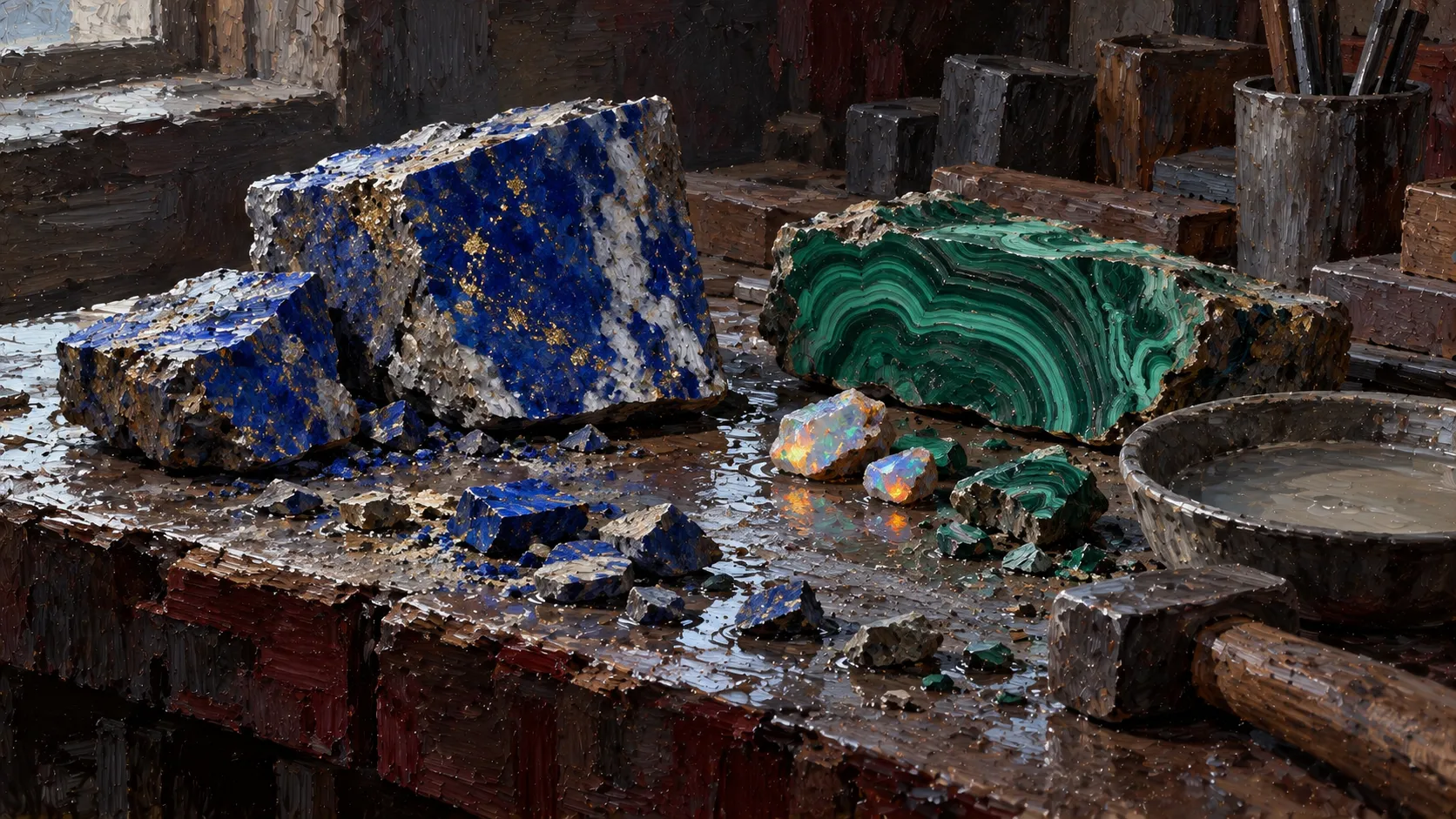
Lapis, malachite, onyx, tiger's eye, opal. Stone dials have the worst yield rate in watchmaking and the best excuse for existing — no two are the same, and no brand can ever reorder one.
Second in a four-part series on dial materials. Meteorite, stone, shell, metal.
Somewhere today, a person who is extremely good at their job is going to destroy a piece of lapis lazuli with a drill bit.
Then they'll pick up the next one and do it again.
That's not incompetence. That's the stone dial business, and once you understand why it happens, these dials get a lot more interesting than "ooh, pretty."
Why it's so hard
A watch dial has to be flat, thin, and pierced.
Flat, because a dial that bows will foul the hands. Thin — typically under half a millimeter — because there's no room. And pierced, because the hands have to come through the middle, which means drilling a hole in the exact center of a brittle mineral slice you've already spent hours preparing.
Stone does not enjoy any part of this.
It's brittle, it has internal fractures you can't see until you're most of the way through, and it has an unhelpful habit of choosing the final operation to fail. Cut, grind, lap, polish, drill — and crack, right at the end, on the piece you'd already invested the most work in.
Then there's mounting. A metal dial gets feet soldered to the back. You cannot solder to a rock, so stone dials are typically bonded to a backing plate, and now you have two materials with different rates of thermal expansion glued together and asked to spend thirty years going from a cold wrist to a hot car.
Every stone dial you've ever admired is the survivor of a process with a genuinely miserable success rate. That is a real part of what you're paying for.
The stones, and what each one is actually doing
Lapis lazuli. The deep, saturated blue, flecked with gold. The gold isn't gold — it's pyrite, and the blue is a mineral called lazurite. The best of it has come from the Sar-e-Sang mines in Afghanistan for something like six thousand years; it's the same source that supplied ancient Egypt, and the same stone that European painters ground into ultramarine, which is why for centuries the Virgin Mary's robe was the most expensive thing on the canvas.
A good lapis dial reads like a night sky. A bad one — too pale, too much white calcite streaking — reads like a countertop. The difference is enormous and entirely visible.
Malachite. Bands of green, from near-black to bright jade. Those bands are growth rings: malachite forms in layers as copper-rich water works through rock, so the pattern on your dial is a cross-section of a very slow chemical process. It's essentially a contour map of somewhere underground.
Soft, though — softer than window glass. Malachite is for the inside of a watch, not the outside of one.
Onyx. Flat, deep, absolute black. And the hardest to get right, because black hides nothing. Any inclusion, any polishing mark, any variation in the surface, and it's obvious. A perfect onyx dial looks like an absence rather than an object — a hole where a dial should be. Getting that requires a stone with no character at all, which is a very strange thing to search for.
Tiger's eye. The one that moves. Tiger's eye forms when fibrous mineral is gradually replaced by quartz, and the fibers stay aligned — so light reflects in a band that slides as you tilt it. The technical term is chatoyancy, from the French for "cat's eye."
Which makes tiger's eye about as on-brand as a material can get around here. It's a dial with a moving highlight built into its own crystal structure. Kinetic art at the mineral level.
Opal. The prima donna. Opal's color isn't pigment at all — it's structure. Microscopic silica spheres, stacked in a regular array, diffracting light into those shifting reds and greens. Same principle as a butterfly wing.
It is also fragile, sensitive to knocks, and can craze — develop a network of fine cracks — if it dries out or takes a thermal shock. An opal dial is a watchmaker choosing chaos deliberately, and the results are unlike anything else on a wrist.
And the ringer: aventurine. Those glittering deep-blue "starry night" dials? Not a stone. Aventurine glass is a man-made material — copper crystals precipitated inside molten glass, a technique refined in seventeenth-century Murano, reputedly discovered by accident, which is how most of the good things in glassmaking happened.
There is a natural mineral called aventurine quartz. It is not what's on your watch. I mention it not to be pedantic but because the man-made version is genuinely beautiful and it doesn't need to borrow anyone's credentials. Murano glassmakers spent centuries perfecting it. That's its own story.
The best thing about stone dials
Here's what I actually love, and it's the same reason meteorite works.
A brand cannot reorder a stone dial.
Every slice comes out of a specific block, from a specific seam, in a specific mine. Cut it and the pattern is whatever the geology decided several million years ago. The next slice is different. The next block is very different. When that seam is worked out, that dial is over — not discontinued, over.
So when a stone-dial watch is described as a limited edition, the limit isn't a marketing decision made in a meeting. It's how much of the rock there was.
There's a lovely consequence to this. Two people can own the "same" watch, same reference, same everything — and own visibly different objects. One has more pyrite. One has a band of malachite that happens to arc through the six o'clock position like a horizon.
That basically never happens anywhere else in manufacturing. Your car is not a unique object. Your phone is emphatically not a unique object.
The watch on your wrist, if it's got a rock on the front of it, is the only one.
A note on looking after them
Briefly, because it matters and nobody says it:
Stone dials are more sensitive to shock than metal ones. Opal in particular does not want thermal extremes. And if a stone dial ever does crack, it usually cannot be replaced with a matching piece, because — see above — there isn't one.
Which is a slightly terrifying thought, and also, I think, the point. It's the same anxiety you'd feel about a painting.
That's what owning art actually feels like.
Next in the series: shell. Mother-of-pearl is an animal's response to an irritation it couldn't remove, and it is the most genuinely kinetic surface in all of watchmaking. Nothing else changes color as you move.